Building Age of Empires for Enterprises
A generation of gamers is becoming managers — and they won't accept anything less than the feeling of playing Age of Empires while running their business. This is the vision behind Interloom.
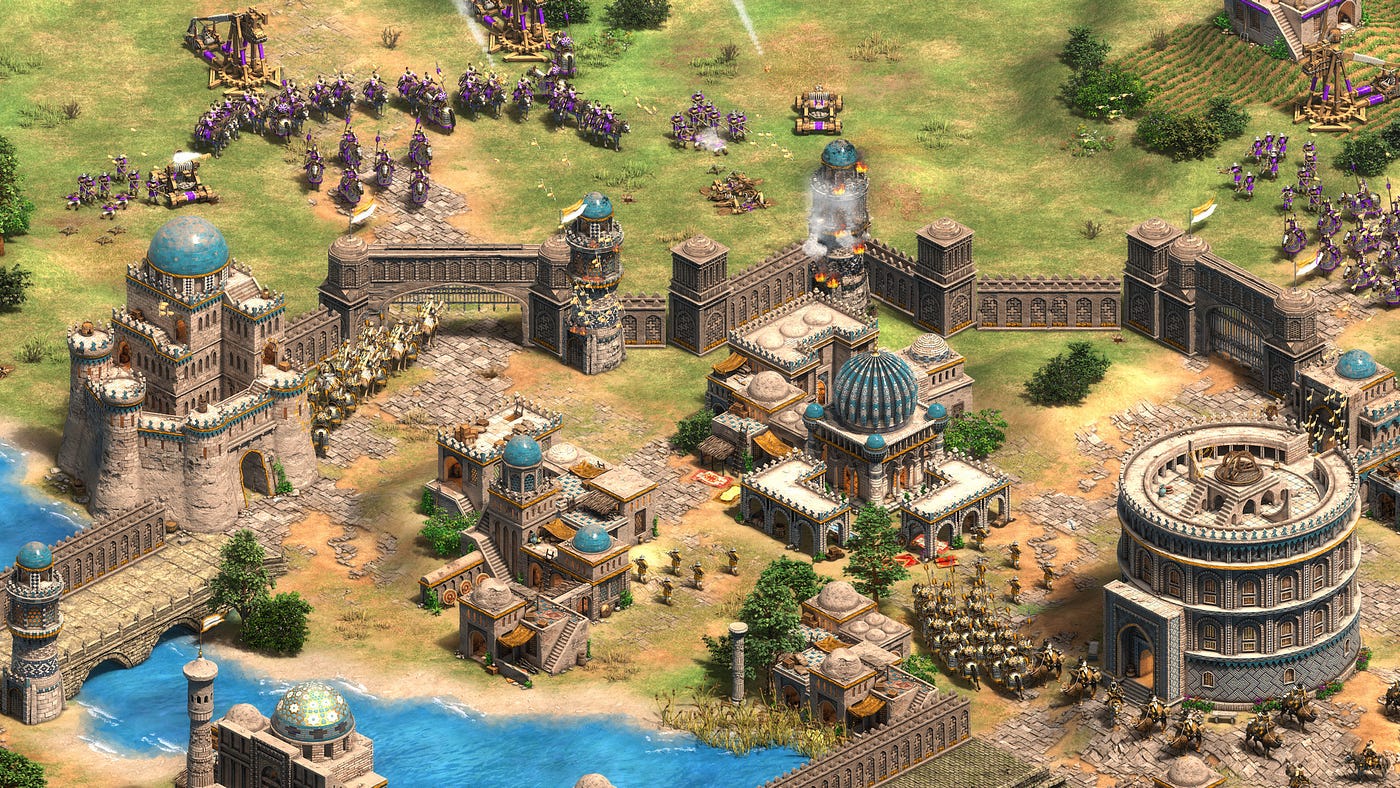
A Generation of Gamers become Managers
I was born in 1987. Like so many of my generation, I was a passionate gamer. To be more specific, I loved playing multi-player strategy games, like Age of Empires, Empire Earth or Star Craft.
What I loved about playing those games was to see my strategy, ecosystem, cities and supply chains worked seamlessly into each other. It gave me a feeling of control and satisfaction — ideally when certain sub-systems, like certain cities and eco-systems would start other function and work on their own, while I could turn to the next strategic move to ultimately win the game.
After I studied finance and economics I started my first software company, and for the most part I have always built my companies the way I played age of empires. With a strategic, long-term perspective on the market, on our customers and how the value we created within those systems played out. Until today, the impact it can have when systems start to function like clockwork excited us as a team and is the key motivation for building Interloom. Which brings me to the title of this article.
The first time I ever saw an SAP instance I was baffled. In fairness, it was an old deployment but I could have never imagined that the software systems that run our society and supply chains across the world can be that rigid. As the "Age of Empires" generation, I naively assumed CEOs and managers around the world can run their companies like we played Age of Empires. Employing and orchestrating the resources and people at their companies to achieve strategic outcomes for their businesses in real-time. With so much power and control over organizations that sometimes employ hundreds of thousands of people, one might assume it would be very efficient to have a general overview of the resources available (money, products, warehouses, factories, etc.) and have the ability to seamlessly orchestrate their employees and collaborate with their employees to deploy those to advance the company and build routines and sub-systems to further that growth.
Little did I know that the world was run on Excel.
It dawn on me that the only reason why I could have this perspective on running a company is because I effectively belonged to the first generation of gamers — simply because games didn't really existed before our teenage years. Which brings me to the vision and also some sort of prediction for the next 10 years. In the next 10 years the "baby boomers" will start to retire or move to the board. This shift is already happening as the oldest millennial turn 40 in the next few years (including myself). My prediction is that through the recent breakthroughs in AI and the crazy market dynamics it brings with it, this transition will accelerate, especially in the relevant technology and CTO teams. Once this happens, we will have an entire generation of ex-gamers as CTOs and C-Levels taking control of the largest companies on the planet.
And my prediction is that none of them will accept anything less than the feeling they had when we all played age of empires while running their business. This includes:
- Real-time Status: A real-time overview of their resources (real time accounting and close (shoutout to Nicolas Kopp for building Rillet) or inventory, products etc.)
- My Objects: An actual representation of their company and the assets (objects) they own (effectively the vision we had for Boxplot building an application layer for knowledge graphs — or effectively Palantir's vision of business ontology)
- Gameplay: A real world model, aka. map and visualisation of their buildings, supply chains, vehicles, vessels, etc. (essentially the virtual representation of reality equivalent to the digital world of Age of Empires gameplay)
- Orchestration: And most importantly the ability to manage and orchestrate the people, AI agents and eventually humanoid robots that will soon be entering their workforce — just like we orchestrated and managed our units, troops, cities, and systems in the strategy games.
None of those expectations are in any way crazy. In fact, it is surprising that incumbent software vendors use a lot of those concepts in their marketing departments but completely do not have a single one of those features built into their actual software around the very same concepts. (The exceptions here proves the rule — namely Palantir at least on the ontology side and gameplay but it is insanely complex and most importantly expensive to "play" that game).
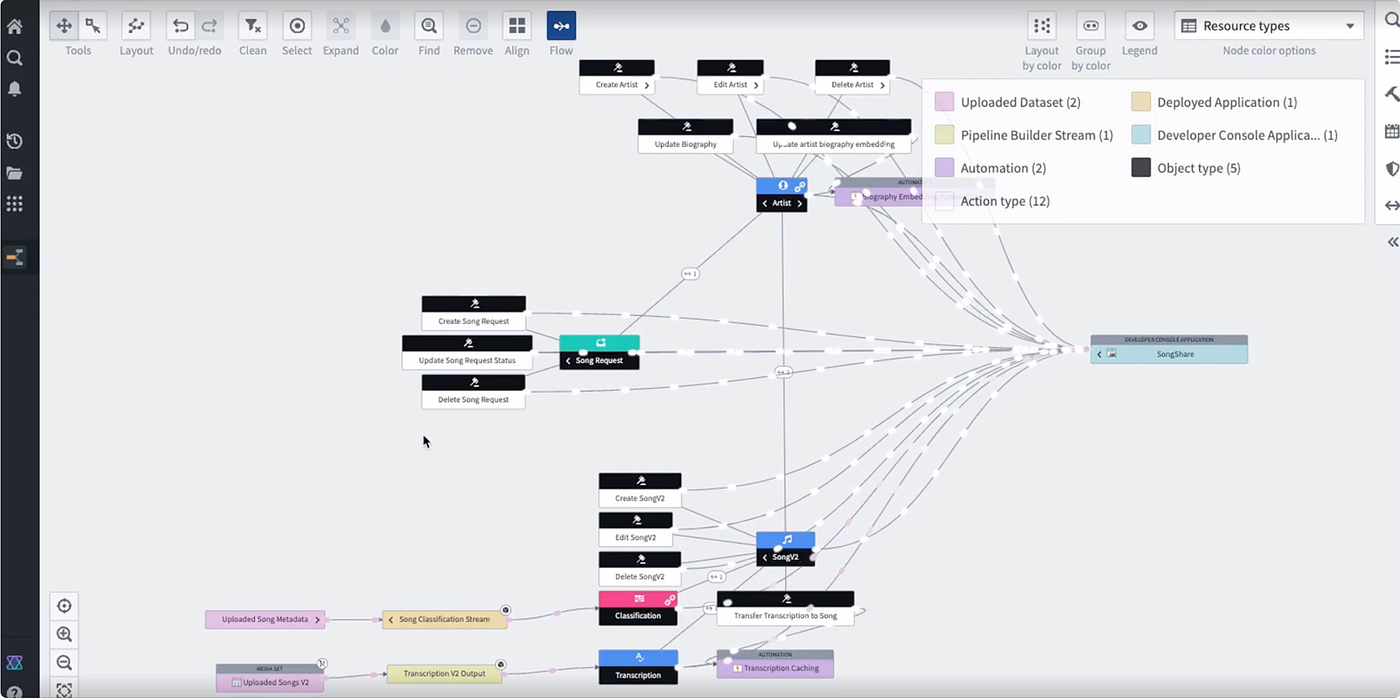
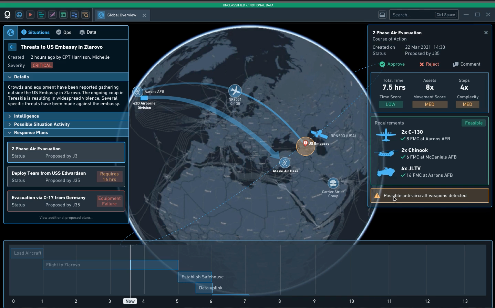
This is obviously not because they don't have capable teams or engineers, but it is simply because these products and infrastructure were never designed with this perspective in mind. SAP was designed as a ledger for double book keeping at a time where servers were still mainly on-prem. They could have just provided us with a service for that ledger, and everybody would be happy. Instead, they have built an extremely expensive and very rigid data modules and custom data models on top of this ledger which now make SAP one of the most expensive and rigid software vendors in the world. While all we needed was a "Enterprise Resource Plan and Trace (ERP)" for simply the bar of Age of Empires. Because that's what it is. The rest is a rigid implementation of the worst version of a strategy game someone could have ever imagined.

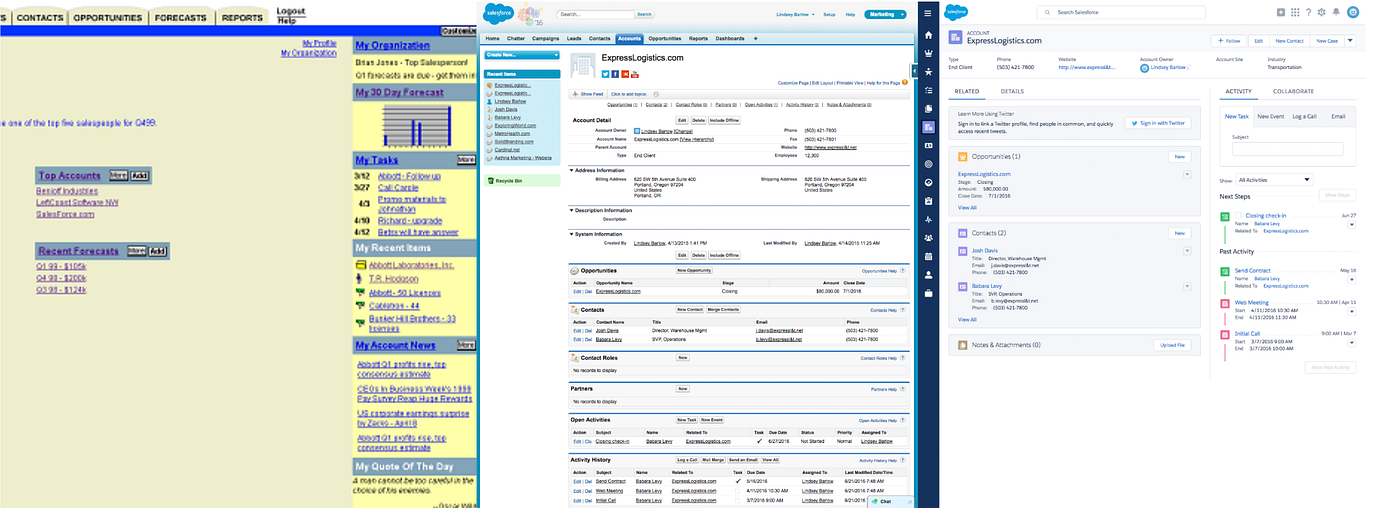
The same is true for Salesforce. As the name implies Salesforce was simply a cloud based sales CRM, which until today has a fixed sales oriented core data model. This is obvious when you look at their current API documentation of their data model — which yes got extended, and amended but in its' core still is a simple data-model of customer, lead, person, opportunity, deal, contract etc. The fact that a lead and a person are literally both a person, required them to change their model a couple years back. These systems where build in a time where handling a decent amount of data in a MySQL database was still a problem. They were built to scale functions like sales, ITSM, finance not to make managing a company easy. They were never built to "play" an enterprise.
It is surprising how little innovation we have seen on how knowledge workers use software — this becomes bluntly clear when you look at the interface evolution of Salesforce from their origins in 1999. In a sense, it is still exactly the same interface — a rigid data model, a user interface for manual data entry and hard coded workflows on top.
While there is obviously a lot of potential for adding AI agents specially for the manual data entry part, I do feel that the current implementations of AI agents on these incumbent platforms will turn out to be extreme horseless carriages over time. There is a great article which I have posted a few months ago that talks about this: https://koomen.dev/essays/horseless-carriages/
Which brings me to the future.
How Enterprise Software will Change
It is not really about replacing SAP yet — or replacing Salesforce. I do believe the systems are massively overpriced for what they do and the implementations are so complex, that just upgrading them is a multi-million dollar project (e.g. SAP Hanna). But there will be a pricing revolution coming, as I can simply not imagine that companies are willing to pay 200 Euros (see Salesforce pricing) per seat, for manually filling out forms. And the current strategy to charge for the AI agents additionally is literally ridiculous. So unless we see an insane 180 from the incumbents on the way they price their software, there is a big opportunity for new companies and startups to not just innovate how we build software for the agentic age, but also how we sell software with the objective and outcome of the businesses and enterprises in mind.
Our vision is simple: We want to make managing a company as fun and seamless as building with Age of Empires.
This is our long term vision for Interloom
We positioned Interloom as a navigation system for work. The analogy we outlined in our previous blog-post is perfect as it is literally technically accurate for the most important component of the future of work: how thousands, and millions of people in businesses will collaborate and work with hundreds, thousands maybe millions of agents that will be available in a few years from now.
However, this change is applied to the "status" of reality. Think about a contact in your phone book — when you look at it and use it, it is that state of the virtual representation (or digital twin) of that person. When you now "edit" the contact, you "change" the state. Effectively all software, however complex or nicely marketed, simply manipulates a virtual representation of the business to arrive at a new state. Database, Front-End, Humans across state and change of the "gameplay".
So on top of the orchestration of work between people and agents, we need to have a representation of the "state". That is what we started Boxplot for in 2020. An application layer that modelled a company in "objects" and their "relationships". My wife Janna and I who started Boxplot just had our first child at the time and as we were bootstrapped and profitable, I had some time to get into Unity and program 2d games for my kids. I loved it, and given I still had to unpack my rusty c#, I was quite proud of the games I built. (this was obviously pre ChatGPT and coding agents — OMG what a world this was).
Unity and developing games really shaped my way of thinking about enterprise software — it deeply influenced me and my co-founders' vision of the world (shoutout to Erik Collinder who since years does not get tired to obsess over this with me). For those of you who don't know Unity, think about it as a program that just provides you with a 3 dimensional space that you can shape to wherever your imagination takes you. Unity (like Microsoft Word) just provides you the empty Canvas to model reality — 3 dimensions, time and… what they call game objects. Game objects was a fascinating idea. I also really like the implementation. While object based programming is not a surprise to anyone, a GameObject in Unity represented something in reality. In order for it to exist, or for anything to exist in a virtual world of a game, one needs to create a GameObject. Professional games like Age of Empires have Millions of Game objects. Every tree, every leaf, every person, unit, building, the ground, the clouds. Anything is a Game object. When I look out the window, what I see today is a world full of Game Objects. And the entire problem of building enterprise software can be described as how to design a system that represents the real world as accurately and as real-time as possible. This is all this is about.
How accurate this analogy is becomes clear when asking the following question:
Why did nobody ever "lose" something in a game. For example why did I never "lose" a coin or a building. Because in Age of Empires as a virtual world, if the object doesn't exist as a game object, it doesn't exist. In the real world however, it is absolutely possible for something to exist, without it being "accounted" for in my enterprise software. What we usually summarize as "bad data quality" essentially just translates to "we have inaccurate, or outdated representation of the reality of a business in our virtual representation layer, or enterprise software".
We can model anything that could potentially exist in the real world in a game engine (modern games are infinitely complex eco-systems and multi-player-online-games even have social structures and trading economies — see Eve Online, World of Warcraft, Fortnite, etc.). Therefore the way we should think about building software for business should simply be modelling an application layer for businesses to build their own "game". So a Unity that enables you to "play" the management of your business.
We have had this vision for a while, but only recently did it become feasible. And the reason is as old as computers are: computers and humans think and communicate differently. Until this ChatGPT moment no computer was even remotely able to contextualise, summarize, understand, reason the way we can do today. It is still insane how much this unlocks and changes, but for the most exciting possibility is that we can finally build a near real-time and near accurate representation of the business — at scale. Because before, every Game object for your business, so every contract, contact, deal, case, ticket, had to be updated manually. Integrations were a fix, but they were costly, rigid and not really scalable across complex eco-systems. Therefore, trying to create a real-time representation of ALL of the objects and their relationships that runs a business like Volkswagen with 600.000 employees literally would be impossible. Until now.
AI agents understand language, voice, images, video, code, anything. They can reflect, summarize, reason, create, update, delete at scale for almost nothing. The best part is we don't even have to really start to work differently — quite the opposite — we will finally be able to solve for the insanely inefficient way of representing the status of the business — manual data entry ("Don't forget to update your 'deals' in Salesforce before the sales meeting on Friday" is hopefully a sentence a CRO in 2 years will never say again).
So now that we can "capture" the gameplay and status of objects it will be possible to literally build an age of empires for businesses. If we know what is, we can plan and orchestrate how to change the status for a better — by simply planning the things that need to be done and the people and agents that should do them. Across dozens, hundreds, thousands and millions of knowledge workers around the world.
The potential is enormous. And it is already proven that it can work. Because when we are able to think about a business and even a large enterprise like a strategy game engine, we can think about the management of it like AlphaStar.
I was more than excited when I first laid my eyes on the AlphaStar paper. DeepMind's AlphaStar, an AI built for the formidable real-time strategy game StarCraft II, was trained using a blend of imitation learning — absorbing strategies from human game replays — and multi-agent reinforcement learning within a competitive league that included exploiter agents to strengthen robustness. The result? AlphaStar ascended to Grandmaster rank, outplaying 99.8% of humans. The research, published in October 2019, is now nearly six years old, but its legacy still shines brightly. (More background and links here.)
We envision the future of work and managing an organization like playing Age of Empires, but with the constant support and supervision by an AlphaStar like agent under the hood. To do so, we have to build the Environment (Interloom = Unity) to model the game and give it the basic pillars of running the game (objects, relationships, activities/time, tasks = control units, etc., world position, framerate = time, event pipeline).
We believe that this can yield a system that learns from mistakes, constantly reinforces the best way to get work done and still keeps us as humans in control (just like the player still decides on the strategy, even if AlphaStar is constantly supporting us). The last point is worth its' own article, because we believe that the AGI narrative constantly underestimates the complexity of this ultimate game: reality. A world model would require the observation of everything in reality. Time, Weather, Money, People, Cars, Houses, those might be feasible. But the interconnected undocumented part of humans interacting with each other and within and across organizations and processes is so infinitely complex, that it will be impossible to predict. That is why intuition, gut feeling, the ability to take calculated risks and also quite frankly the ability to try to avoid pain and failure on a human scale makes us humans an irreplaceable part of this "world game".
We are technology and AI enthusiasts. But we are also humanists. We believe that many good things can come from humans, agents and robots working together to make the world a better, fairer place.
And we will do our part by building the Age of Empires for Business and an AlphaStar-based Navigation System for Work Orchestration between billions of knowledge workers, and millions of agents for thousands of companies around the world.
I personally cannot wait to play this game.